Skip to content
Cystic Fibrosis News Today logo Newsletter
Newsletter
  • About CF
    What is cystic fibrosis?
    • Symptoms
    • Diagnosis
    • Causes and inheritance
    • Types of CFTR mutations
    Treatment
    • Approved treatments
    • Experimental treatments
    • Non-drug treatments
  • Living with
    Living with CF
    Heat and humidity tips
    Upper and lower respiratory tract infections
    Tips for preventing reflux
  • News
  • Community
    Columns
    • Air of Life — Ed Jordan
    • Living Beyond – Jennifer Cogliano
    • Valiant Voice — Lara Govendo
    • Victorious — Brad Dell
    • Mutations & Conversations — Tré LaRosa
    Archived columns
    • Advocacy and Abnormality — Kristin Entler
    • Understanding Nonsense — William Ryan
    Videos
    • CF love story
    • CF travel tips
    • Shaping change in the CF community
    • Talking about struggles
    Features
    • Rediscovery
    • CF Vests Worldwide
  • Forums
  • CF Spotlight
  • What can we help you find today?

Cystic fibrosis guide to clinical trials

Last updated Aug. 5, 2025 by Agata Boxe
✅ Fact-checked by Patrícia Silva, PhD

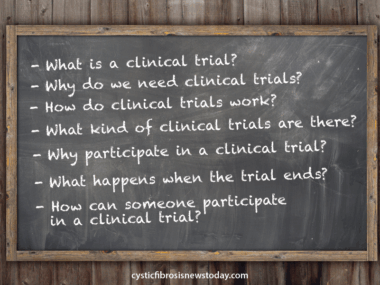
What is a clinical trial?
Benefits and risks
Types of CF clinical trials
Where to find
Questions to ask
Additional information


Although researchers have made significant progress with therapies for cystic fibrosis (CF), many aspects of the disease remain challenging to treat. Among them are worsening lung function and persistent lung infections, as well as other symptoms that affect daily life.

Scientists have been trying to address these issues through clinical trials, which test new therapies in people before they can be approved by the U.S. Food and Drug Administration (FDA) or regulatory agencies in other countries.

Joining a CF clinical trial can give you access to experimental treatments that may work for you while also helping researchers better understand CF.

However, if you’re considering joining a CF clinical trial, be sure to talk to your doctors first to determine whether it’s a safe and appropriate option for you.

What is a CF clinical trial?

Clinical trials for CF are research studies that examine new methods for treating, managing, or diagnosing CF. They’re usually done after lab and animal testing, helping scientists understand whether a CF therapy is safe and effective.

Clinical trials for CF can focus on:

  • testing new medications to improve lung function or treat infections
  • developing gene or mRNA therapies for CF
  • studying treatments for specific symptoms, such as breathing or gastrointestinal issues
  • assessing new diagnostic tools or imaging techniques.

There are different phases of CF clinical trials:

  • Phase 1 trials typically test the safety and dosage of a treatment in a small group of people.
  • Phase 2 trials usually assess the effectiveness of the treatment and continue safety monitoring.
  • Phase 3 trials generally compare the new therapy with standard options or a placebo in a larger group of people.
  • Phase 4 trials are done after FDA approval to monitor long-term effects in a real-world setting.

The benefits and risks of CF clinical trials

The progressive nature of CF may play a role in why someone would be open to accepting the risks involved in trials. Still, it is essential to carefully weigh those risks and benefits before considering potentially participating in one.

The benefits of CF clinical trials include:

  • early access to promising new CF treatments
  • a chance to try to manage your condition proactively
  • contributing to the advancement of CF therapies for the broader community.

The risks of CF clinical trials include:

  • potential side effects from the experimental treatment
  • a possible lack of improvement or worsening of symptoms
  • the possibility of receiving a placebo or standard treatment instead of the new therapy
  • additional time for appointments, testing, or travel
  • costs that may not be covered by insurance or the study sponsor.

Types of CF clinical trials

There are several types of CF clinical trials, each with a different focus. They can explore a range of treatment goals, such as:

  • testing antibiotics, anti-inflammatory drugs, or therapies for chronic infections
  • easing symptoms, such as those related to breathing or digestion
  • evaluating lifestyle and rehabilitation interventions focused on exercise, airway clearance, or diet, among others
  • using biomarkers or imaging to better understand CF progression or predict treatment response.

Some CF trials enroll people with specific genetic mutations, while others may target those who haven’t responded to existing CF therapies. Other trials may have different goals.

Where to find CF clinical trials

To learn more about ongoing or new clinical trials in cystic fibrosis, first speak with your CF doctors. Members of your healthcare team may be aware of trials through hospitals, research centers, or national networks. They can let you know if you may be a good candidate.

Publicly accessible websites and databases can also provide additional information.

For trials in the United States, you can consult these sources:

  • ClinicalTrials.gov
  • CenterWatch
  • the Cystic Fibrosis Foundation
  • Emily’s Entourage
  • the Mayo Clinic.

Sources for trial opportunities outside the U.S. include:

  • the EU Clinical Trials Register
  • the European Cystic Fibrosis Society
  • CF Europe
  • the CF Trust (UK)
  • the ISRCTN Registry (UK)
  • Cystic Fibrosis Australia
  • Cystic Fibrosis Canada.

What to ask before joining a CF trial

Asking questions can help you decide whether or not to participate in a trial. You may find it helpful to know exactly what to ask your CF doctor, the research team, and yourself as you are exploring the process.

Questions for your CF doctor

Your doctor can answer general questions about CF trials, such as:

  • Am I a suitable candidate for a CF clinical trial?
  • Do you know of any clinical trials that would be appropriate for my disease stage and symptoms?
  • Would trial participation affect my current CF treatment plan?
  • What are the potential risks and benefits of the trial you may be recommending?
  • What would the trial require in terms of treatment, travel, and time commitment?

Questions for the research team

More detailed questions can be asked of researchers running the trial:

  • What kind of treatment will the trial be testing, and why do you think it will work?
  • Are there any known side effects, and, if so, how can they be managed?
  • Does this study involve a placebo or another CF treatment that is already on the market?
  • What are the odds of receiving a placebo or another CF treatment versus the new treatment?
  • Who will cover the costs of my participation in the trial, and do I need insurance?

Asking about potential costs is especially important. Although most trials tend to cover the costs of the experimental treatment and any related medical care, that may not be the case for every single study.

If you are insured, you might want to ask your insurer whether or not the company can pay for your participation in the study, as well as care for potential side effects.

Questions to ask yourself

Participating in a clinical trial is a personal decision that should be made with careful consideration.

These self-reflective questions may help you make a decision:

  •  How do I hope to benefit from the trial, and are my expectations realistic?
  • Am I willing to accept the risks, such as potential side effects or a chance of receiving a placebo?
  • How may this trial affect my daily life?
  • Am I willing to accept the time commitment and potential travel and expenses related to the trial?
  • Do I feel ready to manage the emotional impact if the new treatment doesn’t work for me?

Additional information about CF clinical trials

CF clinical trials can provide a chance to try experimental treatments and give you more of a voice in your CF care. However, it is essential to keep in mind that these studies are not suitable for everyone, so it’s important to take the time to understand their risks and benefits.

Prioritize talking to your CF doctors first, so they can help you decide whether a CF trial is an option for you. And don’t hesitate to ask questions and advocate for yourself as you make this and other key decisions about your health and future.


Cystic Fibrosis News Today is strictly a news and information website about the disease. It does not provide medical advice, diagnosis, or treatment. This content is not intended to be a substitute for professional medical advice, diagnosis, or treatment. Always seek the advice of your physician or other qualified health provider with any questions you may have regarding a medical condition. Never disregard professional medical advice or delay in seeking it because of something you have read on this website.

Clinical trial news

October 2, 2015 Social Clips by Isaura Santos

Clinical Trial FAQs – All You Need To Know

Check out the Frequently Asked Questions (FAQ) for clinical trials, and what the process involves. Read more here: https://bit.ly/1j4TxSt Print This Page…

September 23, 2015 News by Patricia Inácio, PhD

Concert Pharma’s Modified Version of Cystic Fibrosis Therapy Ivacaftor Outperforms Kalydeco in Early Testing

Concert Pharma recently announced successful results from a Phase 1 single ascending dose clinical trial for their lead investigational drug CTP-656 as a therapy for cystic fibrosis. Cystic fibrosis is a life-threatening disease characterized by a progressive lung function decline and is caused by mutations in the Cftr gene (cystic fibrosis transmembrane…

August 7, 2015 News by Patrícia Silva, PhD

TORPEDO-CF Clinical Trial Seeks Participants for Antibiotic Study

Patients living with cystic fibrosis (CF) are at increased risk for acquiring and developing severe respiratory infections. The most worrisome pathogen is Pseudomonas aeruginosa (PsA), which is treated with powerful antibiotics either via oral, intravenous, or inhaled antibiotics. While these treatments are known to work, there has yet to be a conclusive…

CF study
July 28, 2015 News by admin

Newly Discovered Gene Therapy Could Help Treat Cystic Fibrosis

An increasing number of studies testing gene therapies are showing promise for treating a wide range of conditions, including cystic fibrosis. Normally in these studies, genes are injected into cells using a virus, however, scientists recently tested a new method of delivering DNA to the faulty CFTR gene in CF through what is called a cationic liposome, a fatty container…

Endogenous Lung Stem Cells and CF
June 30, 2015 News by Daniela Semedo, PhD

ProQR Starts Enrollment of Patients for Phase 1b Study of QR-010 in Cystic Fibrosis

ProQR Therapeutics N.V. a company developing RNA medicines for the treatment of severe diseases including cystic fibrosis, recently announced that it has initiated the enrollment of patients into PQ-010-001, a Phase 1b clinical trial for QR-010. The compound is a new RNA-based therapeutic drug designed to restore the genetic mutation in the mRNA…

  • Previous Prev
  • 1
  • …
  • 38
  • 39
  • 40
  • 41
  • 42
  • 43
  • Next Next
  • Previous Prev
  • Next Next

Your CF Community


Visit the Cystic Fibrosis News Today forums to connect with others in the CF community.

Recent Posts

  • The importance of food safety for a transplant recipient with CF December 5, 2025
  • Life expectancy is a useful metric, but it doesn’t tell the whole story December 4, 2025
  • Finding comfort in routine after a heartbreaking CF diagnosis December 3, 2025
  • Panel recommends revised dosing for trial of CF treatment BX004 December 2, 2025
  • Understanding physiological effects of anxiety and chronic illness November 28, 2025


Envelope icon

Subscribe to our newsletter

Get regular updates to your inbox.

This field is for validation purposes and should be left unchanged.

Bionews, Inc.

3 W Garden St
Suite 700
Pensacola, FL 32502
Website: bionews.com
Email: [email protected]
Phone: 1-800-936-1363

  • About Us
  • Leadership
  • Our Culture
  • Editorial Policy
  • Advertising Policy
  • Corrections Policy
  • Terms of Service
  • Privacy Policy
  • Careers
  • Contact Us
Disclaimer

This site is strictly a news and information website about the disease. It does not provide medical advice, diagnosis or treatment. This content is not intended to be a substitute for professional medical advice, diagnosis, or treatment. Always seek the advice of your physician or other qualified health provider with any questions you may have regarding a medical condition. Never disregard professional medical advice or delay in seeking it because of something you have read on this website.

Copyright © 2013-2025 All rights reserved.